
Once you go beyond single room events, the same rules of good event management apply: good planning, good organisation, clear communication and good timing. It doesn’t matter if you are running a plenary session with break-out groups or running parallel workshops and exhibitions.
Match Rooms To The Event Shape
Start with your event’s programme and match your chosen rooms to it. If you have one main session and two to three other groups then book a combination of a plenary and syndicate rooms of appropriate size. Don’t book rooms on an ad-hoc basis hoping that somehow or other they will work. They won’t.
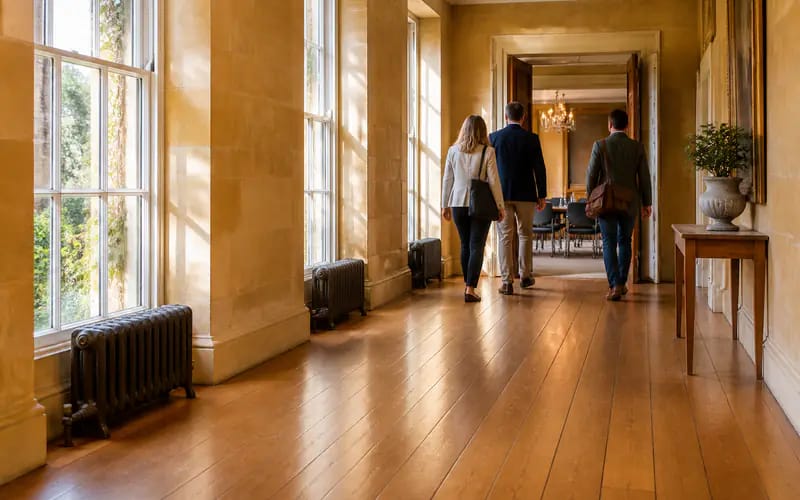
Plan Clear Routes Between Rooms
For events with multiple sessions held in different rooms, ensure that delegates can move around the hotel easily and know where to go next. Walk around the hotel and identify the best route between rooms and post clear information on the corridors leading to each space. Simple A5 printed information displayed on easels in the corridors is best – avoid taping up paper to the walls as these tend to fall down by lunchtime.
Stagger Timings Across Rooms
In order to ensure that all delegates are able to access the catering, stagger the end times of the sessions held in the various rooms by 5-10 minutes to ensure that the groups arrive at the food and drink in a gradual and even trickle of people. This is especially important at lunchtime when a buffet-style service is operating and a steady queue of people is expected, not a stampede of 80 people all arriving at the same time.
Check Each Room’s AV Separately
Even rooms within the same hotel can vary from a plug and play setup to a fully equipped theatre. It is also worth remembering that smaller conference rooms can have limited AV equipment. It is better to check the AV equipment for each room individually than to assume that because it worked in the main conference room it will work in the smaller conference rooms. Check the number of microphones, what cables are supplied, if there is a lectern and if it has a screen. Also check if the Wi-Fi password is the same for all the rooms. See also Cotswolds Hotel Conference Rooms.
Name A Contact Per Room
On a busy multi-room event the organiser cannot be everywhere to deal with all the problems that will arise. Match each conference room with a contact, be this the hotel staff or your own, and ensure that they can deal with any problems that may arise in that room. Speakes can then report any problems with their speaking time or microphones not working to this contact.
Use Shared Spaces As Overflow
You also need to think about your overflow spaces between sessions. More often than not a hotel has a great foyer area, an outdoor terrace or a lounge that can be used for the majority of your event for these purposes and will generally be unused for the majority of the day. It is therefore well worth considering them when planning your event.
Book Changeovers Into The Schedule
Another point to consider is how long it will take to move furniture around to rearrange the room from a boardroom configuration to a theatre style for example, or from a workshop style to rows of seating. This should be booked with the venue in advance and it is best to establish who will be responsible for moving the furniture and how long it will take. Also check that the room will be free at the required time for changeover.
Check Exits And Capacity In Every Room
Small rooms need just as much thought and planning in terms of fire exits, maximum capacity and how people with disabilities can move around the room as larger spaces. In planning an event that is being held across multiple rooms in a hotel or venue, the safety checks for each room must be carried out. The government’s guidance on planning a public event sets out how licensing, capacity limits and safety checks apply when an event is being held in a venue that is being used across multiple spaces.
All of these points can be read and put into practice before your next multi-room event – and then all will go well and people will move about where you want them to!