
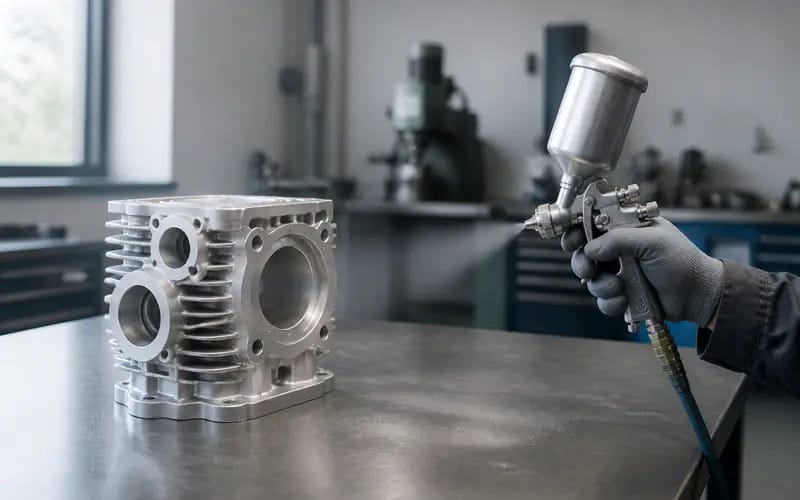
Thermal Spray Coating on aluminium parts calls for a careful approach.
As is well known, aluminium behaves differently from steel or from titanium when a spray gun is aimed at it. In order to develop a process for spraying aluminium parts one must have considerable respect for the metal.
Why Heat Input Matters More
Aluminium has a relatively low melting point when compared to steel and typically has a number of processing temperatures before it starts to melt. To obtain a suitable coating on aluminium parts the thermal spray gun must be run at reduced power with the spray gun positioned further away from the part surface and with shorter dwell times on each spray pass over the part surface. If the thermal spray processing is carried out incorrectly then aluminium parts can distort such as warping or even become oval shaped in sections such as bores within parts.
Grit Blasting Without Damage
Surface roughening of the part with grit blasting before coating with thermal spray is non-negotiable. However, blast pressure that is suitable for steel can easily embed grit in soft aluminium or even cause a thin-walled housing to distort. Lower blow pressures in combination with softer blasting media (e.g. aluminium oxide of reduced grade) are required in order to generate sufficient ‘key’ for good adhesion without causing any damage to the substrate.
Choosing The Right Bond Coat
It’s also important to note that aluminium parts experience a lot of thermal expansion and contraction. This causes many common coatings to crack and flake as the part is cycled between hot and cold. A special bond coat, typically made of a nickel-aluminium or molybdenum-based material, can help alleviate this problem by absorbing some of the coefficient of thermal expansion (CTE) mismatch between the aluminium part and the top coat. If no bond coat is used, coating failure typically becomes evident weeks to months after application, when coating begins to peel at edges of parts.
Common Coating Materials For Aluminium
The coating material to apply to the aluminium parts can vary greatly. For wear resistance on moving parts, for example, aluminium bronze sprays are very often used. For thermal protection of parts exposed to exhaust or hot fluids, for example, the spray coating can be of a ceramic type or zirconia-based.
Masking Close-Tolerance Features
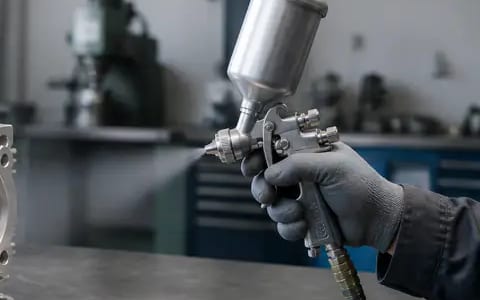
For precision parts with bores, threads and mating surfaces that need to be left exactly as machined, these areas are masked up with items like high-temperature tape, metal shields or spray-part-specific plug & mask sets before the coating work commences. The sprayer then uses carefully set up fixturing that holds the part securely in place and does not touch it in such a way as to cause damage due to heat. A part that is not fixed properly will shift about in the spray booth mid pass and thus cause coating thickness to vary all over the surface of the part.
Controlling Heat Build-Up Across A Job
For aluminium, a single spray pass does not normally cause problems. But for subsequent passes on the same area, cooling time is required, and even then, air blowing off the part or a short delay can be sufficient. Temperature measurement with an infrared gun is used during the spraying operation to measure the part’s temperature and prevent it from softening and distorting. Suitable values for the spray process for different aluminium alloys are well established in thermal spraying techniques.
Typical Aluminium Parts That Get Sprayed
There are several types of parts sprayed including pump housings, heat sinks, hydraulic blocks and even marine fittings. Most of these parts require a harder wearing surface than bare aluminium and also may require increased corrosion resistance. Some parts may only require one of these characteristics but in most cases both are necessary.
Checking The Part Before It Goes Back Into Assembly
When coating has been applied to a part it is necessary to check for the bond strength of the coating to the aluminium surface. As aluminium has large thermal expansion it can cause large mismatch between coating and aluminium. Therefore it is very important to check dimensionally after coating to see if the part has gone out of tolerance. Uneven heat application can cause parts to warp when put back into service.
Spraying aluminium parts to create a working surface that is harder than the aluminium itself and will last for years can be done well if due care is taken before spraying and the spraying process is controlled with respect to temperature.