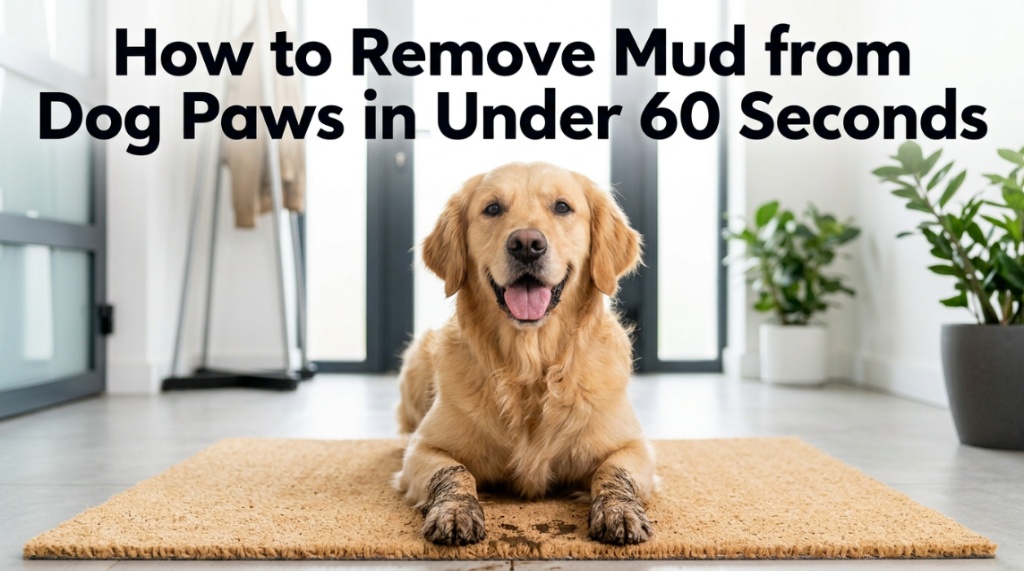
Last Tuesday, my neighbor’s Labrador bolted through a rain-soaked garden bed and tracked a perfect set of muddy prints across her freshly mopped kitchen floor — all in the three seconds it took her to grab a towel. That daily battle between muddy walks and clean floors is one every dog owner knows too well. A proper dog paw wash routine takes less than 60 seconds per paw when you use the right technique and tools, turning a frustrating mess into a quick doorstep habit that protects your floors, furniture, and your dog’s paw health simultaneously. The problem is not that cleaning muddy dog paws is difficult — it is that most owners use slow, ineffective methods that frustrate both them and their dogs. This guide breaks down the fastest proven techniques, the tools that actually speed up the process, and the exact step-by-step routine that gets your dog from muddy to floor-ready in under a minute.
Why Is Quick Paw Cleaning Important After Every Walk?
Quick paw cleaning prevents mud from drying and hardening between paw pads (making removal painful), stops bacteria and allergens from entering your home, and protects your dog from irritants like road salt, pesticides, and fungal spores that hide in wet soil.
Mud is not just dirt and water. Outdoor mud contains:
- Bacteria: Leptospira, E. coli, and other pathogens thrive in wet soil
- Chemical residues: Lawn pesticides, herbicides, and fertilizers cling to mud particles
- Allergens: Pollen, mold spores, and environmental irritants concentrate in wet ground
- Parasites: Hookworm larvae and other parasites live in contaminated soil
- Road salt (winter): Causes chemical burns between paw pads if not removed
Beyond home cleanliness, quick paw washing is a health practice. Dogs that walk through contaminated mud and then lick their paws ingest whatever was in that soil. A 60-second wash eliminates this exposure pathway entirely.
The speed factor matters because dogs have limited patience for paw handling. A 5-minute scrubbing session teaches your dog to resist paw cleaning. A 60-second routine teaches them it is quick and painless — building cooperation over time rather than resistance.
What Is the Fastest Method to Clean Muddy Dog Paws?
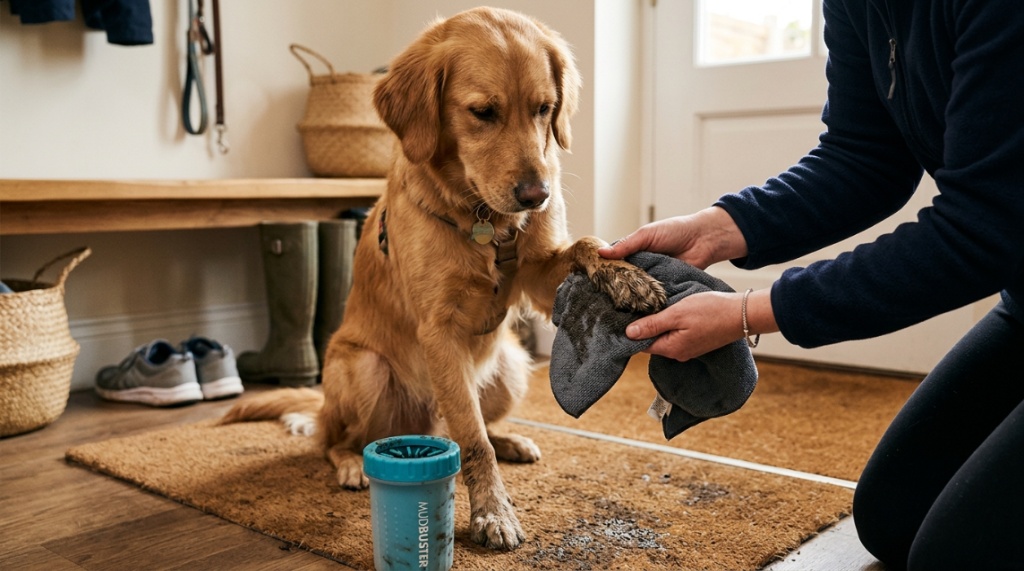
The fastest method is a portable paw washer cup — you insert the paw, twist gently for 10–15 seconds, remove, and towel dry. Total time per paw: 15 seconds. Total for all four paws: under 60 seconds.
Here is the complete 60-second routine:
- Seconds 1–5: Fill paw washer with lukewarm water (pre-staged by the door)
- Seconds 5–20: Insert front left paw, twist cup gently 3–4 rotations, remove
- Seconds 20–35: Insert front right paw, repeat twist motion
- Seconds 35–50: Rear paws (dogs are usually more cooperative with rear paws after fronts are done)
- Seconds 50–60: Quick towel pat on all four paws
The twist motion is key — the silicone bristles inside the cup agitate mud from between paw pads without scrubbing. Water does the heavy lifting while bristles reach crevices your fingers cannot. This method works faster than towels, wipes, or basin soaking because it combines water, agitation, and containment in a single motion.
Which Tools Clean Dog Paws the Fastest?
Portable paw washer cups (like Dexas MudBuster), silicone paw cleaning mats, and microfiber mitt towels rank as the three fastest paw cleaning tools — each suited to different mud levels and dog sizes.
| Tool | Best For | Time Per Paw | Mud Level | Dog Size |
|---|---|---|---|---|
| Paw washer cup (silicone bristles) | Heavy mud, between-pad cleaning | 10–15 seconds | Heavy | Small to large (size-specific cups) |
| Silicone paw cleaning mat | Light mud, quick wipe-and-walk | 5–8 seconds | Light to moderate | All sizes |
| Microfiber mitt towel | Damp paws, surface mud | 8–10 seconds | Light | All sizes |
| Spray bottle + towel combo | Moderate mud when no washer available | 12–15 seconds | Moderate | All sizes |
| Outdoor paw rinse station | Extremely muddy dogs, post-hike | 20–30 seconds | Extreme | Medium to large |
For daily use after regular walks, a paw washer cup handles 90% of situations. Keep it pre-filled by your entry door so there is zero prep time when you return from walks. For a comprehensive guide on choosing the right cleaning tool for your specific needs, check out the best dog paw cleaner options that work in muddy conditions year-round.
How Do You Train a Dog to Accept Quick Paw Cleaning?
Train paw cleaning acceptance through gradual desensitization — start by rewarding paw touches, progress to holding paws briefly, then introduce the cleaning tool with treats, building to a full routine over 5–7 days of short positive sessions.
Most dogs resist paw cleaning because it was introduced abruptly and associated with restraint. The fix is systematic:
Day 1–2: Paw touch conditioning
- Touch each paw briefly, immediately reward with a high-value treat
- 10 repetitions per session, 2 sessions per day
- Goal: dog offers paw willingly when you reach toward it
Day 3–4: Paw holding
- Hold each paw for 3–5 seconds, reward upon release
- Gradually increase hold duration to 10–15 seconds
- Goal: dog remains relaxed with paw held
Day 5–6: Tool introduction
- Let dog sniff the paw washer cup or towel, reward
- Touch the tool to paws without cleaning, reward
- Brief 2-second cleaning motion, reward heavily
Day 7+: Full routine
- Complete one paw, reward. Complete second paw, reward.
- Gradually reduce treats to one reward after all four paws
- Within 2 weeks, most dogs stand calmly for the full 60-second routine
The critical rule: never force or restrain during training. A dog that learns paw cleaning is quick and rewarding cooperates for life. A dog that learns it involves being held down resists forever.
What Water Temperature Works Best for Paw Washing?
Lukewarm water (around body temperature, 98–100°F) works best because it dissolves mud faster than cold water while remaining comfortable for sensitive paw pads — cold water causes dogs to pull away, and hot water risks burns.
Water temperature affects both cleaning efficiency and dog cooperation:
- Cold water: Dogs flinch and pull away, especially in winter. Mud dissolves slowly. Cleaning takes longer.
- Lukewarm water: Comfortable for paw pads. Dissolves mud quickly. Dogs tolerate it well. Optimal choice year-round.
- Warm water: Dissolves mud fastest but risks being too hot for sensitive pads. Test on your inner wrist first — if it feels warm but not hot, it is safe.
In winter, lukewarm water also soothes paws irritated by cold pavement, ice, or road salt. It acts as both a cleaning agent and a comfort measure, making dogs more willing to stand still for the process. Pre-fill your paw washer with lukewarm water before the walk so it is ready the moment you return.
Should You Add Soap or Cleanser to the Paw Wash Water?
Plain lukewarm water removes mud effectively for daily washes. Add a small amount of dog-safe paw cleanser only when dealing with sticky substances, chemical exposure, or visible irritation — never use human soap, dish soap, or harsh detergents on paw pads.
When plain water is sufficient (90% of situations):
- Regular mud from walks
- Wet grass and dirt
- Light sand or gravel dust
- Normal daily paw maintenance
When to add a dog-safe cleanser:
- Sticky mud mixed with sap or tar
- After walking on treated lawns (pesticides/herbicides)
- Road salt exposure in winter
- Visible redness or irritation between pads
- Fungal concerns (yeast-prone dogs)
Dog-safe paw cleansers use gentle surfactants and often include soothing ingredients like aloe or oatmeal. Human soaps strip natural oils from paw pads, causing dryness and cracking. Dish soap is particularly harsh and should never contact paw pads regularly — it destroys the protective lipid layer that keeps pads supple and crack-resistant.
How Do You Clean Extremely Muddy Paws When a Quick Wash Is Not Enough?
For extremely muddy paws (mud caked between pads and up the legs), use a two-stage approach: first rinse with a low-pressure hose or outdoor basin to remove bulk mud, then follow with the paw washer cup for between-pad detail cleaning — total time 90–120 seconds.
Extreme mud situations (post-hike, after rain puddle play, muddy dog parks) overwhelm a single paw washer cup. The two-stage method handles any mud level:
Stage 1: Bulk removal (30–45 seconds)
- Use a garden hose on low pressure or a pre-filled basin
- Rinse from ankle down, letting water carry away surface mud
- Do not scrub — water pressure alone removes 80% of surface mud
- For winter: use a large bowl of lukewarm water instead of a cold hose
Stage 2: Detail cleaning (45–60 seconds)
- Paw washer cup with fresh water for between-pad cleaning
- Focus on the crevices between toes where mud compacts
- Check for debris (small stones, thorns, burrs) lodged between pads
- Towel dry thoroughly, especially between toes
This two-stage approach prevents you from trying to force heavily muddy paws into a small cup (which just creates muddy water that redeposits on the paw) and ensures complete cleaning even after the muddiest adventures.
How Do You Dry Dog Paws Properly After Washing?
Dry paws thoroughly using a microfiber towel with a gentle squeeze-and-pat motion — focusing especially between the toes where trapped moisture causes yeast infections, bacterial growth, and interdigital cysts if left damp.
Drying is the step most owners rush or skip entirely. Wet paws walking on indoor floors still leave marks, and chronic dampness between toes creates health problems:
- Yeast overgrowth: Warm, moist environments between toes are ideal for Malassezia yeast — causing red, itchy, smelly paws
- Bacterial infections: Moisture trapped between pads creates conditions for bacterial dermatitis
- Interdigital cysts: Chronic moisture irritation can trigger painful cysts between toes
- Pad softening: Constantly wet pads become soft and vulnerable to cuts and abrasions
Proper drying technique:
- Use a dedicated microfiber dog towel (more absorbent than cotton)
- Wrap the towel around each paw and squeeze gently — do not rub aggressively
- Spread toes apart and pat between each one
- For long-haired breeds, use a low-heat blow dryer on the paw fur if heavily saturated
- Total drying time: 15–20 seconds per paw
What Mistakes Make Paw Cleaning Take Longer Than Necessary?
Understanding why your dog’s ears emit a bad odor and how ear wipes can be beneficial.
Common mistakes and their fixes:
- Mistake: Wiping heavy mud with a dry towel → Fix: Always use water first for anything beyond light dampness
- Mistake: Searching for supplies after the walk → Fix: Permanent paw station by your entry door with pre-filled washer, towel, and treats
- Mistake: Letting mud dry on paws → Fix: Clean immediately upon entry — dried mud requires soaking and takes 3x longer
- Mistake: Wrestling a resistant dog → Fix: Invest 7 days in desensitization training (saves hundreds of hours long-term)
- Mistake: Cleaning one paw at a time while dog walks around → Fix: Position dog on a mat or in a designated spot before starting
- Mistake: Using a too-small paw washer → Fix: Size up — a cup that fits loosely cleans faster than one the paw barely enters
Conclusion
Removing mud from dog paws in under 60 seconds is entirely achievable with the right setup: a pre-filled paw washer cup by your door, lukewarm water, a microfiber towel, and a dog trained to cooperate through positive reinforcement. The technique is simple — insert, twist, remove, dry. Four paws, one minute, clean floors.
The investment is minimal: a $15 paw washer cup, a dedicated towel, and one week of training. The return is massive: no more muddy footprints, no more wrestling matches at the door, no more choosing between a clean home and giving your dog the outdoor exercise they need. Start tonight — pre-stage your supplies by the door and time yourself on tomorrow’s walk. You will wonder why you ever did it any other way.
What is your fastest paw cleaning hack? Share your routine below and help fellow dog owners win the battle against muddy floors.
Frequently Asked Questions
Can I use baby wipes instead of a paw washer for muddy paws?
Baby wipes work for light surface dirt but cannot remove mud packed between paw pads. They smear heavy mud rather than removing it, and many contain fragrances or chemicals that irritate sensitive paw skin with daily use. For heavy mud, a water-based paw washer is significantly faster and more thorough. Reserve wipes for light dust or dry-weather touch-ups only.
How do I clean dog paws when traveling without my usual supplies?
Use a disposable cup or water bottle with a sock or bandana as a towel. Fill the cup with water, dip each paw briefly, and wipe with the fabric. Hotel ice buckets work perfectly as improvised paw washers. In a pinch, wet paper towels from a gas station restroom handle light mud adequately until you reach proper supplies.
Should I clean my dog’s paws after every single walk?
Clean paws after every walk that involves wet or muddy surfaces, treated lawns, salted roads, or unfamiliar terrain. Dry-weather walks on clean pavement may only need a quick towel wipe. The rule: if paws look dirty or wet, clean them. If they are dry and visually clean, a brief inspection is sufficient.
My dog has furry paws — does that make cleaning harder?
Yes, long fur between paw pads traps more mud and takes longer to dry. Trim the fur between pads to pad-level using blunt-tip scissors or a small clipper. This reduces mud accumulation by 60–70% and cuts drying time in half. Most groomers include paw pad trimming in standard grooming sessions — request it specifically if yours does not.
Can frequent paw washing damage my dog’s paw pads?
Daily washing with plain water does not damage paw pads. However, frequent use of soap or chemical cleansers strips natural oils and causes dryness and cracking. Stick to plain water for daily washes and use cleansers only when genuinely needed. Apply a dog-safe paw balm weekly if you notice any dryness from frequent washing.
What is the best paw cleaning routine for rainy seasons?
During rainy seasons, upgrade your setup: place a waterproof mat inside your entry door, keep two paw washers (one in use, one drying), stock extra towels, and consider a boot tray for your dog to stand on during cleaning. The routine stays the same — the infrastructure just needs to handle higher frequency without creating its own mess.
Do paw cleaning sprays actually work faster than water?
Paw cleaning sprays (waterless cleansers) work faster than water only for light surface dirt and allergen removal. For actual mud, they cannot compete with water-based washing because mud requires physical agitation and rinsing to remove from between pads. Sprays are best as a supplement for dry days, not a replacement for wet-weather paw washing.