
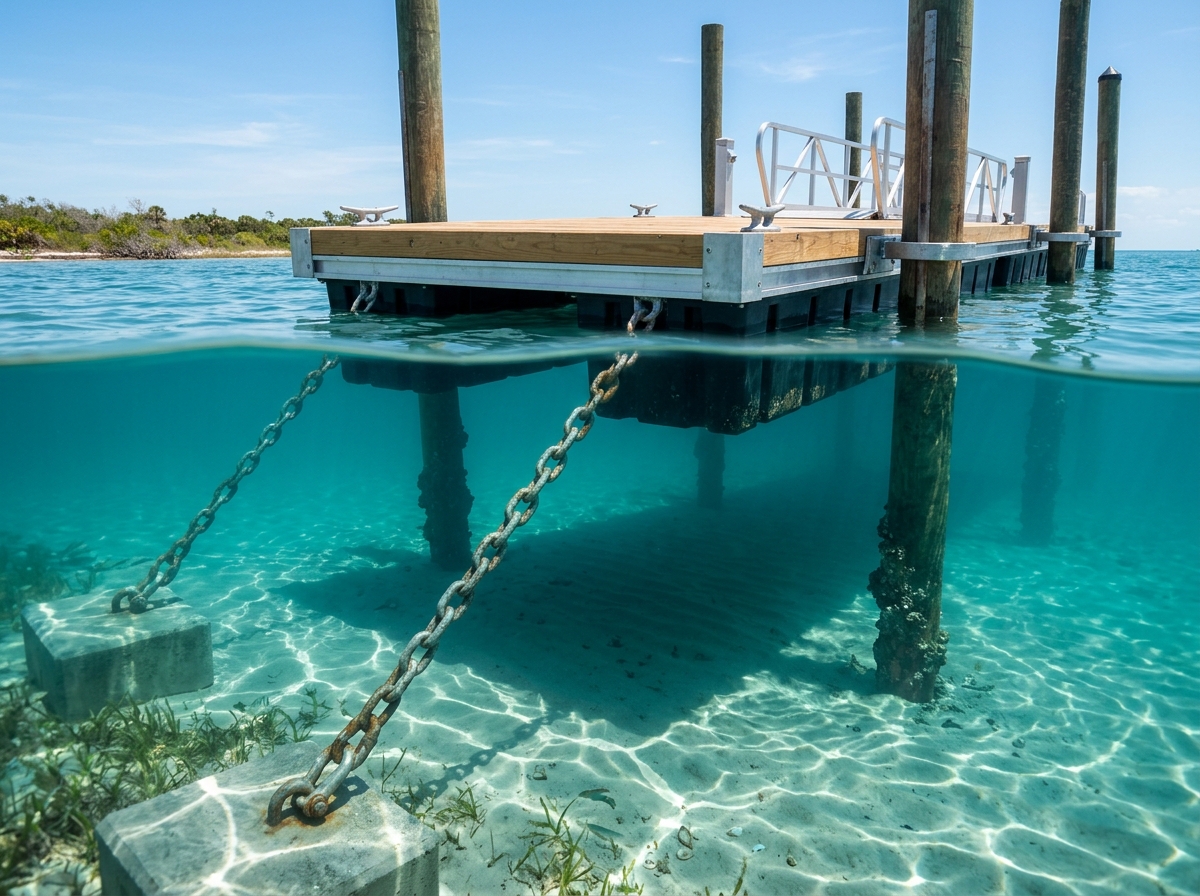
A floating dock looks free to wander, yet the good ones stay exactly where they were installed through storms, ice, and falling water. Anchoring does that job, and it hides under the surface where few people ever look. Understanding how the main systems work makes it easier to judge what a dock really needs.
Pile Guides and Posts: The Classic Vertical Track
Pile systems use fixed posts driven or set into the bottom, with the dock sliding up and down along them through hoops or brackets. They hold position firmly and let the deck follow every change in water level. That makes them a favorite on lakes and tidal sites where depth swings by several feet.
Soil decides whether piles make sense. Firm clay and compact sand grip posts well, while soft muck lets them lean over the years and solid rock may stop a driver completely. Guides also need smooth, low-friction contact, since binding hoops can pin a dock down as water rises. Tall piles in open water take real wind and wave load too, so diameter and embedment depth deserve a proper calculation.
Cable and Block Systems for Shallow or Rocky Bottoms
Where piles will not work, cables and weights step in. Heavy concrete blocks sit on the bottom, and steel cables run to the dock from two or more directions so no single pull can drag it off line. Chain sections near the anchor add weight that keeps the angle low and absorbs sudden jerks.
Line length makes or breaks these setups. Cables sized for the deepest expected water keep tension steady, while short ones yank on connections when levels climb. Seasonal checks matter because lines stretch and blocks can creep in soft sediment. Shoppers browsing aluminum boat docks for sale should ask what anchoring hardware ships with the system and how it suits their bottom.
Helical Anchors and Shore Connections
Helical anchors look like giant screws that twist into the lakebed, and they grip soft soil far better than loose blocks. Divers or specialized equipment install them, and a proper torque reading confirms they bite deep enough. Some sites combine them with cables for a firm hold that avoids driving piles.
Shoreline connections work just as hard. Hinged ramps, gangways, and shore-side posts take up the motion between land and water, and a ramp that binds shoves force into the first dock section. An aluminum floating dock depends on those joints moving freely, since stuck hardware turns normal rise and fall into stress on the frame.
Which System Fits Which Site?
Water movement, bottom type, and exposure narrow the choice quickly. Rivers and tidal channels push from changing directions, so multi-angle cable layouts or sturdy pile guides handle them best. Ice-prone lakes often call for removable sections or pile setups that let the dock lift with the sheet. Calm coves forgive lighter hardware, while open fetch demands heavier everything.
Many projects blend methods, using piles near shore and cables or helical anchors farther out. A quick probe of the bottom and a look at wind and wave exposure usually reveal the right mix. Businesses feel the stakes most, since a drifting dock can take a slip out of service or put boats at risk.
Warning Signs and Care for Anchoring Hardware
Drift is the clearest red flag. Slack lines, stretched cables, fresh scrapes on pile guides, and bent cleats all point to hardware working harder than planned. Check bolts, shackles, and connections each spring and after major storms, and replace worn parts early. Floating dock builders who keep spare hardware in stock make that upkeep simple. Anyone comparing aluminum docks for sale can also ask how easily anchoring parts can be inspected and swapped.
Matching an anchoring plan to a specific shoreline takes site data and experience, which is where Flotation Systems earns its place. They design custom aluminum boat docks for homes, resorts, and marinas, and its team selects piles, cables, or helical anchors based on soil, depth, and exposure. Depth readings, bottom notes, and a few shoreline photos give them enough to recommend a setup that stays put season after season.